
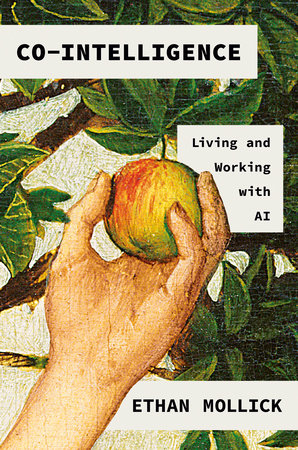
The Loom and the Algorithm
In 1801, Joseph Marie Jacquard unveiled a loom controlled by punched cards: a machine that could weave patterns no human hand could replicate at speed. Silk weavers in Lyon rioted, fearing obsolescence. They were wrong about the loom destroying craftsmanship, but right about one thing: the nature of what it meant to weave had changed forever. Two centuries later, we stand before a different kind of loom. This one weaves not silk but thought itself, language, code, images, strategy, and the pattern cards are written in natural language rather than punched holes. Ethan Mollick's Co-Intelligence argues that we are neither the weavers nor the obsolete. We are something the Lyon craftsmen never imagined: co-creators with the machine. But what does that co-creation demand of our imagination, our innovation, and our creativity? And what happens when the loom begins to dream?
The Thesis: An Alien Mind at the Table
Mollick, a professor of management at Wharton specialising in entrepreneurship and innovation, does not write Co-Intelligence as a tech evangelist or a doomsayer. His central thesis is deceptively simple yet profoundly unsettling: generative AI is not a tool in the conventional sense; it is a new form of intelligence, alien in origin, human in mimicry, and unprecedented in its implications. When ChatGPT launched in November 2022, it was adopted by 100 million users faster than any product in history, and Mollick recognised immediately that what had entered the world was not merely a software upgrade. It was, as he frames it, a co-intelligence: a partner capable of augmenting, challenging, and in some domains surpassing human cognitive work.
The book's narrative spine is structured around a transformation: from viewing AI as an obedient tool to treating it as a collaborative entity with its own peculiar strengths and blind spots. Mollick organises his argument across chapters that move from understanding what AI is (an 'alien mind' built on token prediction) to practical frameworks for working alongside it, in classrooms, boardrooms, and creative studios. The reader who enters the book thinking of AI as autocomplete leaves it rethinking the architecture of expertise itself.
The Author's Lens: Pragmatism Over Prophecy
What distinguishes Mollick is his empirical pragmatism. Where others theorise, Mollick experiments. He ran studies with Boston Consulting Group that showed AI-assisted consultants outperforming their unassisted peers by significant margins on creative and analytical tasks. His Wharton classroom became a live laboratory for AI integration, and his Substack newsletter One Useful Thing documents these experiments with scientific rigour and a practitioner's impatience for abstraction. His philosophical stance is neither utopian nor dystopian; it is resolutely pragmatic, concerned with what works, what fails, and what demands human vigilance.
"I believe the cost of getting to know AI, really getting to know AI, is at least three sleepless nights."
— Ethan Mollick, Co-Intelligence
Five Key Insights: Mining the Jagged Frontier
Mollick's work is dense with counterintuitive findings. Here are five insights that reshape how we should think about imagination, innovation, and creativity in the age of AI.
Narrowing the View: AI's Impact Across Nine Job Categories
Mollick's framework gains urgency when we narrow the lens to specific professions. Drawing on data from the World Economic Forum's Future of Jobs Report 2025, PwC's Global AI Jobs Barometer, and McKinsey's workforce analyses, the following chart maps both the automation risk and augmentation opportunity across nine critical job categories. The pattern is striking: the jobs most at risk of task automation are often the same ones with the highest augmentation potential. The variable is not the technology; it is how humans choose to engage with it.
The data reveals a paradox Mollick would recognise: customer service faces 90% task automation risk, yet only 50% augmentation opportunity: the floor is disappearing faster than a new one can be built. Contrast this with healthcare, where 40% automation risk meets 90% augmentation opportunity, AI amplifies rather than replaces. Software engineering and data analytics sit at the critical intersection where both metrics exceed 70%, making them the professions where Mollick's centaur-cyborg choice is most consequential. Workers and students must understand that the question is not whether AI will reshape their field, but how quickly they must become orchestrators rather than executors.
The Exponential Curve: How Workers and Students Must Evolve
The World Economic Forum estimates that 1.1 billion jobs could be transformed by technology over the next decade, with AI and information processing affecting 86% of businesses by 2030. PwC finds that workers with AI skills already command wage premiums up to 56% higher than peers in identical roles. Gartner predicts that by 2026, 20% of organisations will use AI to flatten their structures, eliminating more than half of current middle management positions. The message is unambiguous: the skills profile that secured employment in 2020 is already insufficient in 2026.
Mollick's framework, read alongside these workforce projections, suggests a five-phase evolution for professionals: from curiosity (first encounter with generative AI) through experimentation (systematic testing of AI capabilities) to integration (embedding AI into daily workflows), then orchestration (designing systems where AI and humans collaborate at scale), and finally co-creation (producing outcomes that neither human nor AI could achieve alone). The skills radar below illustrates the shift in competency profiles this evolution demands.
Notice the inversion: technical expertise, once the dominant dimension, becomes less critical than AI literacy, adaptability, and critical thinking. Creativity, which many assumed AI would diminish, actually increases in importance, because the ability to ask the right questions, frame novel problems, and evaluate AI-generated output becomes the differentiating human skill. As Cal Newport argues in Deep Work and as Daniel Kahneman's research on cognitive biases reminds us, the ability to think slowly, critically, and with genuine depth is precisely what AI cannot replicate; and what organisations will pay premiums for.
Seven Takeaways: Expand and Contract
The following takeaways distil Mollick's arguments into actionable strategies; each paired with guidance for going deeper and for quick reference.
Takeaway 1: Always Invite AI to the Table
Contract (Remember)
→ Principle: If you haven't tried it with AI, you haven't tried it yet.
→ Metaphor: AI is the uninvited guest who improves every dinner party
→ Rule: When starting any task, first ask 'How would AI approach this?'
→ Anchor: The empty chair; always leave a seat for AI at the table
Takeaway 2: Be the Human in the Loop, Always
Contract (Remember)
→ Principle: Trust AI's speed, but verify with human judgement.
→ Metaphor: The pilot who monitors autopilot; always ready to take the controls
→ Rule: Never publish, send, or act on AI output without a human review pass
→ Anchor: The 'red pen'; every AI draft gets marked up before it ships
Takeaway 3: Treat AI Like a Person, Then Define Its Role
Contract (Remember)
→ Principle: The quality of AI's output mirrors the clarity of its assignment.
→ Metaphor: AI is a brilliant intern, capable but directionless without a brief
→ Rule: Before every AI interaction, specify: role, audience, constraints, format
→ Anchor: The casting call, always audition AI for a specific part
Takeaway 4: Map Your Own Jagged Frontier
Contract (Remember)
→ Principle: AI's boundaries are personal, discover yours empirically.
→ Metaphor: The jagged coastline; you cannot know it from a map; you must walk it
→ Rule: Every month, test AI on one task you assumed it couldn't handle
→ Anchor: The frontier map: a living document of AI's strengths in your work
Takeaway 5: Shift from Craft Hours to Creative Judgement
Contract (Remember)
→ Principle: In the AI era, taste and judgement are the scarce resources.
→ Metaphor: The chef vs. the recipe, AI can follow recipes; only humans create cuisines
→ Rule: When AI produces the draft, your job becomes editor-in-chief, not author
→ Anchor: The curator's eye, value shifts from production to selection
Takeaway 6: Build Adaptive Capacity, Not Fixed Plans
Contract (Remember)
→ Principle: Plan for uncertainty, not for any single AI future.
→ Metaphor: The delta, not the dam, let strategy flow and adapt
→ Rule: Every quarterly review, reassess your AI integration strategy
→ Anchor: The three horizons, what's working now, what's emerging, what's on the edge
Takeaway 7: Become a Centaur First, Then Learn to be a Cyborg
Contract (Remember)
→ Principle: Master the division of labour before you dissolve it.
→ Metaphor: Learn to ride a bicycle before you race a motorcycle
→ Rule: For routine tasks, delegate to AI. For novel problems, fuse with AI.
→ Anchor: The two modes, toggle between centaur and cyborg as tasks demand
Stress-Testing the Thesis: Six Angles of Challenge
A responsible reading of Co-Intelligence requires asking what Mollick's framework leaves unexamined. The following challenges are not dismissals; they are invitations to sharpen the thesis.
| Dimension | Challenge | Implication |
|---|---|---|
| Economic Equity | AI augmentation benefits accrue disproportionately to those already possessing digital literacy and institutional access. | Without deliberate policy, co-intelligence could widen rather than narrow inequality. |
| Cognitive Science | Human-AI collaboration may erode deep thinking skills through automation complacency: the 'deskilling' paradox. | Maintaining human expertise requires intentional practice, not just oversight. |
| Organisational Sociology | Mollick's framework assumes individual agency, but institutional inertia, power dynamics, and cultural resistance shape AI adoption more than personal readiness. | Organisational change management is the missing chapter. |
| Complex Systems | The jagged frontier metaphor implies predictability through mapping. But emergent AI capabilities create non-linear, unpredictable shifts. | The frontier moves faster than any map can capture; continuous adaptation is non-negotiable. |
| Global South Perspective | The book is grounded in Western, English-language, knowledge-economy contexts. AI's impact on agriculture, informal economies, and non-English speakers is largely absent. | Co-intelligence is a different beast outside the Wharton classroom. |
| Decision Theory | Treating AI as a 'person' risks anthropomorphisation that obscures its actual mechanisms, token prediction, not understanding. | Useful metaphor, but dangerous if taken literally. AI does not reason; it patterns. |
Despite these challenges, Mollick's thesis holds because it is fundamentally about posture, not prediction. The four principles are robust precisely because they do not depend on any single vision of AI's future; they prepare the practitioner for all of them.
Who Should Read This Book
This book is for anyone whose work involves thinking, which, in an economy increasingly automated of its manual and routine components, means nearly everyone. It is especially valuable for executives navigating AI strategy without technical backgrounds, educators rethinking assessment and pedagogy, entrepreneurs seeking to use AI as a force multiplier, and mid-career professionals anxious about relevance. If you read one book on AI this year, Mollick's pragmatic, experiment-first approach makes Co-Intelligence the strongest candidate. It is accessible to beginners yet substantive enough for those already fluent in AI discourse.
Limitations and Complementary Reading
No single book captures the full complexity of AI's impact. Mollick's work is deliberately practical and present-focused, which means it underweights long-term alignment risks explored in Stuart Russell's Human Compatible and the structural economic analyses found in Daron Acemoglu and Simon Johnson's Power and Progress. The book's reliance on early-stage experimental data means some findings may not survive replication. Readers should also engage with Erik Brynjolfsson and Andrew McAfee's The Second Machine Age for historical context, and with Cal Newport's Deep Work for strategies on preserving the human cognitive depth that AI cannot replicate.
The Loom Dreams: A Closing Provocation
Remember the Jacquard loom? Here is what history does not usually tell you: the silk weavers who survived the disruption were not those who smashed the machines or those who surrendered to them. They were the ones who learned to read the punched cards; who understood the machine's logic well enough to design new patterns it had never been programmed to weave. They became, in Mollick's language, co-intelligences: human imagination fused with mechanical capability, producing beauty that neither could achieve alone.
We stand at the same loom. The cards are written in natural language now. The patterns are more complex than silk could ever hold. And the question Mollick poses, the one that should keep you up for at least three sleepless nights, is not whether AI will transform your work. It is whether you will be the weaver who reads the new cards, or the one who waits to be woven out of the pattern entirely.
"Rather than making us weaker, technology has tended to make us stronger. The key is to keep humans firmly in the loop."
— Ethan Mollick, Co-Intelligence
References
- Acemoglu, D., & Johnson, S. (2023). Power and Progress: Our Thousand-Year Struggle Over Technology and Prosperity. PublicAffairs.
- Brynjolfsson, E., & McAfee, A. (2014). The Second Machine Age: Work, Progress, and Prosperity in a Time of Brilliant Technologies. W. W. Norton.
- Catmull, E. (2014). Creativity, Inc.: Overcoming the Unseen Forces That Stand in the Way of True Inspiration. Random House.
- Daugherty, P. R., & Wilson, H. J. (2018). Human + Machine: Reimagining Work in the Age of AI. Harvard Business Review Press.
- Epstein, D. (2019). Range: Why Generalists Triumph in a Specialized World. Macmillan.
- Hoffman, R. (2023). Impromptu: Amplifying Our Humanity Through AI. Dallepedia LLC.
- Kahneman, D. (2011). Thinking, Fast and Slow. Farrar, Straus and Giroux.
- Mollick, E. (2024). Co-Intelligence: Living and Working with AI. Portfolio / Penguin Random House.
- Newport, C. (2016). Deep Work: Rules for Focused Success in a Distracted World. Grand Central Publishing.
- PwC. (2025). The Fearless Future: 2025 Global AI Jobs Barometer. PricewaterhouseCoopers.
- Russell, S. (2019). Human Compatible: Artificial Intelligence and the Problem of Control. Viking.
- Taleb, N. N. (2012). Antifragile: Things That Gain from Disorder. Random House.
- World Economic Forum. (2025). Future of Jobs Report 2025. World Economic Forum.
- World Economic Forum. (2026). Four Futures for Jobs in the New Economy: AI and Talent in 2030. World Economic Forum.
Adjacent Resources
1. Impromptu by Reid Hoffman (2023)
Relevance: Real-time experiments with AI as conversational partner, extends Mollick's 'treat AI like a person' principle into practice.
Best for: Leaders wanting immediate, hands-on AI interaction models.
Key insight: The best way to understand AI is to have a conversation with it.
2. Thinking, Fast and Slow by Daniel Kahneman (2011)
Relevance: The cognitive biases Kahneman maps are precisely the vulnerabilities that AI-human collaboration either exploits or mitigates.
Best for: Anyone wanting to understand why 'human in the loop' is psychologically harder than it sounds.
Key insight: System 1 thinking is the Achilles heel of AI oversight.
3. Antifragile by Nassim Nicholas Taleb (2012)
Relevance: Mollick's four futures map directly onto Taleb's framework for building systems that gain from uncertainty.
Best for: Strategists building AI-resilient organisations.
Key insight: Don't predict the future; build capacity to benefit from any future.
4. Range by David Epstein (2019)
Relevance: In a jagged-frontier world, generalist breadth may outperform specialist depth: a direct complement to Mollick's argument.
Best for: Mid-career professionals worried about relevance.
Key insight: Breadth of experience is the new competitive advantage in AI-augmented work.
5. Power and Progress by Daron Acemoglu & Simon Johnson (2023)
Relevance: The contrarian perspective: technology only benefits broadly when institutions deliberately direct it toward shared prosperity.
Best for: Policy-makers and executives concerned with equitable AI deployment.
Key insight: Innovation alone has never guaranteed shared benefit, institutional design does.