
The Chrysalis
A caterpillar does not decide to fly. It does something far more radical—it dissolves. Inside the chrysalis, its body breaks down into a formless soup of cells called imaginal discs—tiny blueprints of a creature the caterpillar has never seen, encoded in biology it cannot comprehend. The old form must liquefy entirely before the new one can emerge. Here is the paradox: the caterpillar’s immune system initially attacks these imaginal cells as foreign invaders, trying to destroy the very future it carries within itself. Only when the imaginal cells reach critical mass do they overwhelm resistance and begin building wings.
What does the butterfly see when it first opens its eyes?
Hold that question. We will return to it—but first, we need to talk about what Ray Kurzweil believes humanity is dissolving into.
The Essence: Exponential Destiny
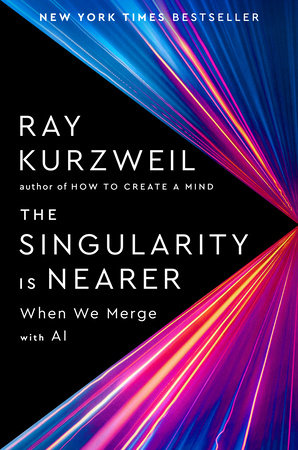
In The Singularity Is Nearer: When We Merge with AI (2024), Ray Kurzweil delivers the sequel to his landmark 2005 work, updating two decades of predictions with the unnerving confidence of a man whose track record demands attention. The central thesis is deceptively simple: technological progress follows an exponential curve so steep that by approximately 2045, artificial intelligence will merge with human cognition, producing a transformation so profound that our current minds cannot fully grasp what lies on the other side. Kurzweil calls this inflection point the Singularity—borrowing from mathematics and physics, where a singularity marks the point at which normal rules break down and something radically new emerges.
But this is not merely a book about technology. Read through the triple lens of imagination, innovation, and creativity, it becomes a manifesto about human potential—an argument that the same cognitive impulse that produced cave paintings, the printing press, and the transistor is now accelerating toward a merger with its own creations. Kurzweil’s Law of Accelerating Returns insists that each technological epoch builds upon the last, compressing timescales with compounding force. What took biology billions of years, brains accomplished in hundreds of millions, and technology in mere thousands. The next epoch, the merger of human and machine intelligence, may unfold in decades.
The Author’s Lens: Engineer as Prophet
Kurzweil brings six decades of work in artificial intelligence, pattern recognition, and invention to this project. His methodology is empirical futurism—marshalling vast datasets on computational power, economic trends, health outcomes, and historical progress to construct what he presents as a scientific forecast rather than speculative fiction. His philosophical commitment is unapologetically optimistic and techno-deterministic: technology is the primary engine of human improvement, and its exponential trajectory is as reliable as a physical law. This lens illuminates extraordinary possibilities—but it also creates blind spots around institutional resistance, inequality, and the messy unpredictability of human social systems.
Key Insights: Five Windows Into the Future
Insight 1: AGI by 2029; The Prediction That Went from Radical to Conservative
In 1999, Kurzweil predicted artificial general intelligence by 2029. He was widely dismissed. Two decades later, expert consensus on forecasting platforms has converged on even earlier dates. Large language models, protein-folding AI, and autonomous research agents have compressed what seemed like a century of progress into a single decade. The insight is not just that Kurzweil was right—it is that even experts systematically underestimate exponential curves because the human brain is wired for linear extrapolation. Imagination, in this context, means training ourselves to think in doublings rather than additions.
Insight 2: Longevity Escape Velocity, Outrunning Death
Kurzweil argues that by the 2030s, medical advances driven by AI will add more than one year of life expectancy for each year that passes—a threshold he calls longevity escape velocity. AI is already transforming drug discovery, diagnostic imaging, protein structure prediction, and surgical robotics. The innovation lens reveals this as the most consequential application of exponential technology: not merely extending life but fundamentally redefining the human lifespan. If true, the economic, philosophical, and social implications dwarf every policy debate of the past century.
Insight 3: The Neocortex in the Cloud, Thinking Without Skulls
The book’s most audacious claim: by the 2030s, nanobots in our bloodstream will connect the neocortex to cloud-based AI, expanding cognition beyond biological limits. This is creativity as architecture—not human creativity improved by tools, but human and machine cognition fused into a single system. Kurzweil envisions us processing on substrates millions of times faster than neural tissue, with the expansion of intelligence becoming a collaborative act between carbon and silicon.
Insight 4: The Abundance Engine; Technology as the Great Equaliser
Kurzweil presents extensive data showing exponential improvements in health, wealth, literacy, sanitation, and food production across centuries. He argues AI will automate production of necessities, food, housing, medicine, clothing, making them radically cheap. Innovation here is not invention for its own sake but a democratising force: each technological revolution has made the previous generation’s luxuries into the next generation’s baseline expectations.
Insight 5: Consciousness as Pattern, You Are Your Information
Perhaps the most philosophically provocative insight: Kurzweil redefines human identity not as biology but as pattern. Consciousness is the information architecture of experience, not the substrate it runs on. If we can map and replicate neural patterns, identity becomes transferable—backupable, even. This challenges every assumption about mortality, selfhood, and what it means to be human. Imagination, innovation, and creativity converge here: imagining ourselves as information, innovating the tools to migrate consciousness, and creating entirely new forms of being.
“It will be a process of co-creation—evolving our minds to unlock deeper insight and using those powers to produce transcendent new ideas.”
— Ray Kurzweil, The Singularity Is Nearer
Key Takeaways: From Insight to Action
Knowledge without application is philosophical entertainment. These takeaways bridge Kurzweil’s vision to decisions you can act on.
🔎 Expand (Go Deeper)
→ Read: The Second Machine Age (Brynjolfsson & McAfee)
→ Try: Plot your industry’s key metric on a log scale for the past 20 years
→ Ask: Where is exponential growth hiding in my field that I’m reading as linear?
→ Connect: Compound interest, evolutionary biology, viral epidemiology
🎯 Contract (Remember)
→ Principle: Linear intuition is the single greatest blind spot in strategic planning.
→ Metaphor: You’re standing at the knee of a hockey stick—the flat part is behind you.
→ Rule: When forecasting tech-driven change, double your most aggressive estimate.
→ Trigger: Every time you say “that’s decades away,” recalculate using exponential curves.
🔎 Expand (Go Deeper)
→ Read: Co-Intelligence (Ethan Mollick, 2024)
→ Try: Spend one week using AI as a thought partner for every major decision
→ Ask: Which of my cognitive tasks am I defending out of identity rather than value?
→ Connect: Centaur chess, augmented intelligence, the extended mind thesis
🎯 Contract (Remember)
→ Principle: The future belongs to those who learn to think with machines, not against them.
→ Metaphor: A centaur (human + horse) beats both the best human and the best horse alone.
→ Rule: Automate the routine; elevate the creative.
→ Trigger: Before starting any knowledge task, ask: “How would I do this with an AI partner?”
🔎 Expand (Go Deeper)
→ Read: Lifespan (David Sinclair); Outlive (Peter Attia)
→ Try: Model your career and financial plan assuming a 120-year lifespan
→ Ask: If I had 60 more productive years, what would I start learning today?
→ Connect: Epigenetic clocks, caloric restriction research, senolytics
🎯 Contract (Remember)
→ Principle: If longevity escape velocity arrives, every plan built on an 80-year life is wrong.
→ Metaphor: You’re building a house—but the plot just got three times larger.
→ Rule: Allocate at least 5% of attention to health-span science—it’s not fringe anymore.
→ Trigger: When making 10-year plans, add a scenario where you’re healthy at 100.
🔎 Expand (Go Deeper)
→ Read: Exponential Organizations (Salim Ismail)
→ Try: Run a “10x thinking” workshop—how would your team solve the problem if forced to scale 10x?
→ Ask: What would a competitor do if they had access to AGI tomorrow?
→ Connect: Platform economics, network effects, zero-marginal-cost production
🎯 Contract (Remember)
→ Principle: Incremental improvement is a losing strategy in an exponential world.
→ Metaphor: You’re optimising your horse-drawn carriage while someone else is building a car.
→ Rule: Dedicate 20% of strategy time to scenarios where current assumptions are obsolete.
→ Trigger: In every annual planning cycle, ask: “What if this market is unrecognisable in 5 years?”
🔎 Expand (Go Deeper)
→ Read: Superintelligence (Nick Bostrom); The Alignment Problem (Brian Christian)
→ Try: Draft your organisation’s AI ethics principles before regulators write them for you
→ Ask: What happens to my workforce, customers, and community if Kurzweil is even half right?
→ Connect: EU AI Act, AI safety research, principal-agent problems in autonomous systems
🎯 Contract (Remember)
→ Principle: The time to shape AI governance is before the technology outpaces the institutions.
→ Metaphor: You don’t build the fire escape after the building is ablaze.
→ Rule: For every AI initiative, assign an ethics review before deployment—not after.
→ Trigger: When someone says “we’ll deal with ethics later,” that’s the signal to deal with them now.
The Human Ripple: What the Singularity Means for Students, Careers, and the Social Fabric
Kurzweil’s projections are dominated by technological milestones—AGI by 2029, nanobots by the 2030s, singularity by 2045. But technology does not arrive in a vacuum. It lands on classrooms, resumes, dinner tables, and community structures. The most important question is not when these technologies arrive, but what they do to the human beings who must absorb them. The singularity’s shockwave radiates outward in concentric rings—hitting students first, then careers, then the social fabric itself.
For Students: The End of the Credential and the Rise of the Capability
If Kurzweil’s timeline is even directionally correct, a student entering university today will graduate into a world where AGI has already arrived. The four-year degree, designed for a world where knowledge was scarce and credentials served as proxies for competence, faces an existential challenge. When an AI can pass any exam, write any essay, and synthesise any body of research, the question shifts from what do you know? to what can you do with an AI that knows everything?
This is not a distant abstraction. AI tutoring systems are already outperforming human tutors in personalised instruction. Kurzweil envisions AI simulating direct sensory experiences by the 2030s—imagine medical students performing surgery in fully immersive environments before touching a real patient, or architecture students walking through buildings that exist only in computation. The imagination lens suggests that education’s future is not the transfer of information but the cultivation of judgment, creativity, ethical reasoning, and the ability to collaborate with non-human intelligence. Students who treat AI as a crutch will be outperformed by those who treat it as a cognitive sparring partner—sharpening questions rather than outsourcing answers.
The practical implication is stark: the half-life of technical skills is collapsing. A programming language learned today may be obsolete in five years. What endures is the meta-skill of learning itself—the ability to dissolve one’s expertise and rebuild it, repeatedly, across a lifespan that may stretch far longer than any previous generation imagined. Lifelong learning is no longer a platitude. It is a survival strategy.
For Careers and the Workforce: The Portfolio Life in an Age of Centaurs
The workforce implications of Kurzweil’s thesis run deeper than the familiar automation anxiety. Yes, AI will displace roles—routine cognitive tasks, data processing, pattern-matching diagnostics, even creative production at commodity levels. But the more profound shift is structural. The idea of a single career—one profession practiced for forty years—was already fraying before generative AI arrived. In a world where AGI can replicate any cognitive skill, the concept of a career must evolve from a ladder into a portfolio: a dynamic collection of capabilities, projects, and human-AI collaborations that shift with the technology landscape.
Kurzweil’s innovation lens reveals an important nuance: the most valuable workers in the near future will not be those who compete with AI but those who form centaur partnerships—human-machine teams that outperform either alone. In advanced chess, centaur teams (amateur human + AI) consistently beat both grandmasters and standalone AI engines. The analogy extends to medicine, law, engineering, finance, and creative industries. The premium shifts from raw expertise to orchestration: the ability to frame problems, evaluate AI outputs with judgment, apply ethical reasoning, and navigate ambiguity where machines falter.
For mid-career professionals, this means a fundamental reorientation. The question is not will my job survive? but which parts of my job are uniquely human, and how do I amplify those parts with AI? Empathy, contextual judgment, stakeholder navigation, creative synthesis under constraint, moral reasoning—these become the durable skills. Everything else is substrate for automation.
For younger workers, the message is even more radical. If longevity escape velocity arrives in the 2030s, a twenty-five-year-old entering the workforce may have eighty or more productive years ahead. That changes every calculation—about specialisation (too risky over long horizons), about savings rates (compound interest over a century is transformative), about risk tolerance (with more runway, bolder bets become rational), and about the very definition of retirement, which may need to be replaced by cyclical reinvention.
For the Social Fabric: Identity, Community, and the Meaning Crisis
Technology reshapes society not primarily through its products but through its redefinition of what it means to be human. Kurzweil’s vision of consciousness as transferable pattern, of minds merged with cloud intelligence, of lifespans measured in centuries rather than decades, strikes directly at the foundations of social life. Consider the implications in three dimensions.
Identity. If the neocortex extends into the cloud, where does “you” end and “the network” begin? Kurzweil argues that identity is already fluid—we are not the same collection of atoms we were a decade ago, and our sense of self persists regardless. But extending cognition into non-biological substrates accelerates this fluidity to a pace that psychological and social structures may struggle to absorb. The creativity required here is not technological but cultural: building frameworks for identity that accommodate radical change without fragmenting into incoherence.
Community. Social bonds are built on shared experience, shared vulnerability, and shared limitation. When limitations dissolve—when disease is optional, scarcity is engineered away, and cognitive capacity becomes a subscription service—what holds communities together? Religious traditions, neighbourhood bonds, national identities, professional guilds—all are structured around shared constraints. Remove the constraints, and the communities must find new connective tissue. This is the singularity’s least discussed and most consequential challenge: not a technological problem but a meaning problem.
Equity. Kurzweil’s data on historical progress, spanning poverty reduction, health improvements, and democratisation, is compelling at civilisational scale. But zoom to a single decade and the picture fractures. Brain-cloud interfaces and longevity treatments will not arrive simultaneously for a farmer in rural Bihar and an executive in Palo Alto. The gap between early adopters and the rest could create, as critics note, not a merged humanity but a bifurcated species. The social fabric depends on a shared sense of human equality; exponential technology threatens that foundation if access remains asymmetric.
The Economy Alongside the Human: From Labour to Creativity to Consciousness
Kurzweil’s economic argument is among his most data-rich and his most provocative. He marshals evidence showing that the cost of computation, energy, food, and manufactured goods has fallen exponentially for decades, and projects this trajectory forward into an era where AI automates the production of virtually all material necessities. The implication is a fundamental restructuring of economic value—not the death of the economy, but its metamorphosis.
Phase 1: The Efficiency Dividend (Now, 2029)
We are living through the first phase. AI augments human productivity—automating customer service, drafting legal documents, accelerating scientific research, optimising supply chains. Economic value still anchors to human labour, but the ratio shifts: fewer humans produce more output. The efficiency dividend is enormous, but its distribution is uneven. Companies that adopt AI early capture disproportionate gains, widening the gap between AI-fluent organisations and laggards. For workers, the phase creates a premium on prompt literacy—the ability to direct, evaluate, and refine AI output—as a new form of professional competence alongside domain expertise.
Phase 2: The Abundance Transition (2029 – 2035)
Once AGI arrives, the cost of cognitive labour approaches zero. Kurzweil argues this will make the production of food, housing, medicine, transportation, and clothing radically cheap. The economic model shifts from scarcity-based pricing to abundance-based distribution. This is where the most intense policy debates will erupt: if machines produce everything, who owns the output? How is wealth distributed? Kurzweil is optimistic—historical precedent shows each wave of automation ultimately created more wealth and more employment than it destroyed. But the transition period is the danger zone. The gap between “jobs destroyed” and “new roles created” could span years or decades, producing a period of severe economic dislocation that tests social safety nets and political systems to their limits.
Universal basic income, once a fringe idea, enters the mainstream in this phase. Kurzweil’s data suggests the economic surplus from AI-driven productivity would be more than sufficient to fund it. The question is not affordability but political will and distribution architecture. Meanwhile, economic value begins migrating from producing things to curating experiences: human attention, aesthetic judgment, emotional connection, and cultural meaning become the scarce resources in a world of material abundance.
Phase 3: The Experience Economy and Beyond (2035 – 2045+)
As human cognition merges with AI through brain-cloud interfaces, the economy evolves beyond traditional measurement. GDP, designed to measure the production of goods and services, becomes increasingly inadequate for capturing value in a world where the most important “products” are expanded consciousness, creative expression, and subjective well-being. Kurzweil hints at but does not fully develop this idea: if intelligence itself becomes the primary economic engine, and intelligence can expand without limit, then growth is no longer constrained by physical resources. The economy becomes post-material—not in the sense that material needs vanish, but that they become so trivially met that they no longer define economic structure.
For today’s business leaders, the practical takeaway is directional: invest in what machines cannot (yet) replicate—judgment under genuine uncertainty, ethical reasoning, cultural production, human connection, and the ability to define problems worth solving. These skills do not automate gracefully because they require the one thing Kurzweil acknowledges science cannot yet define: consciousness itself.
Stress-Testing: A Multi-Dimensional Perspective
Every framework has its shadows. A responsible reading of Kurzweil requires evaluating the strength of his argument across multiple disciplinary lenses—and confronting the challenges his optimism does not fully address. The lenses enable the reader to form a latticework on which they can rest their interpretation, stress-test assumptions, and develop a directional view.
| Dimension | Score | Challenge | Implication |
|---|---|---|---|
| Technological Evidence | 9/10 | Strongest dimension. Exponential trends in computation, AI, and biotech are well-documented. Hardware trajectory is compelling. | The technology case is hard to dismiss—it is the foundation Kurzweil builds everything upon. |
| Economic Impact | 8/10 | Data on abundance is strong historically, but assumes smooth transitions. Decades of displacement may precede equilibrium. | The path between here and abundance passes through severe economic dislocation. |
| Cognitive Science | 7/10 | Brain-as-computer metaphor may be limited. Consciousness might depend on embodiment in ways pattern-transfer cannot capture. | If identity is more than information, the “backup your mind” thesis is incomplete. |
| Philosophical Depth | 7/10 | The identity chapter is genuinely thought-provoking, but consciousness is treated as an engineering problem rather than a hard problem. | Readers with philosophical training will find the treatment suggestive rather than rigorous. |
| Ethical Consideration | 5/10 | Acknowledges existential risk but does not engage deeply with leading AI safety thinkers like Yudkowsky or Bostrom. | Optimism without robust risk analysis may produce complacent readership. |
| Social Feasibility | 4/10 | Data spans centuries, masking decade-level inequality. Nanobots may arrive—but for whom first? Access asymmetry could bifurcate humanity. | Exponential technology without exponential access creates division, not merger. |
These tensions do not invalidate Kurzweil’s thesis—they sharpen it. His work is most compelling when read as a directional vector rather than a precise timetable: the trajectory is clear even if individual milestones shift by years. The most useful approach for professionals is to plan for Kurzweil being directionally right while preparing for the social, ethical, and economic aspects.
Who Should Read This Book
This book is for executives navigating AI-driven transformation, entrepreneurs building in emerging technology, investors modelling long-duration trends, students choosing fields of study that will outlast the current paradigm, policymakers crafting AI governance, educators redesigning curricula for a post-AGI world, and anyone whose professional identity is entangled with a future that may look unrecognisable within their career. Sceptics benefit as much as enthusiasts—Kurzweil’s data, if nothing else, forces a reckoning with timelines.
The Butterfly Opens Its Eyes
We began with a caterpillar dissolving into imaginal soup—its immune system attacking the very cells that carry its future. Kurzweil’s thesis is that humanity is inside the chrysalis right now. Our institutions, our assumptions about mortality, our definitions of intelligence and identity—these are the caterpillar’s body, resisting the imaginal discs of exponential technology. The dissolution feels like crisis. It is, in fact, metamorphosis.
The economy migrating from labour to creativity to consciousness—that is the imaginal disc building a wing.
So, what does the butterfly see when it first opens its eyes?
It sees a world built for crawling—and realises it can fly.
Kurzweil believes humanity stands at that threshold. The question is not whether the singularity will arrive—it is whether you will be among those building wings, or among those still defending the caterpillar’s skin. If the Law of Accelerating Returns is even directionally correct, then every organisation, every career, every curriculum, every social contract, every economic model is about to be stress-tested by a future arriving faster than our linear minds can intuit.
The chrysalis is cracking. The real question is not what the butterfly sees—it is what it decides to do next.
What are you dissolving to become?
References
- Kurzweil, R. (2024). The singularity is nearer: When we merge with AI. Viking.
- Kurzweil, R. (2005). The singularity is near: When humans transcend biology. Viking.
- Bostrom, N. (2014). Superintelligence: Paths, dangers, strategies. Oxford University Press.
- Brynjolfsson, E., & McAfee, A. (2014). The second machine age. W. W. Norton.
- Mollick, E. (2024). Co-intelligence: Living and working with AI. Portfolio.
- Sinclair, D. (2019). Lifespan: Why we age—and why we don’t have to. Atria Books.
- Christian, B. (2020). The alignment problem. W. W. Norton.
- Ismail, S. (2014). Exponential organizations. Diversion Books.
- Attia, P. (2023). Outlive: The science and art of longevity. Harmony Books.
- Harari, Y. N. (2017). Homo Deus: A brief history of tomorrow. Harper.
Adjacent Resources
- Homo Deus by Yuval Noah Harari (2017), A counterweight: explores how technology may create new forms of inequality rather than universal uplift. Best for sceptics and policy thinkers.
- Life 3.0 by Max Tegmark (2017). Explores the full spectrum of AI futures, from utopia to catastrophe, with deeper engagement on safety than Kurzweil provides.
- Co-Intelligence by Ethan Mollick (2024); The most practical guide to human-AI collaboration available. Essential for professionals adapting now, not in 2045.
- The Age of Spiritual Machines by Ray Kurzweil (1999); The precursor that established Kurzweil’s track record. Essential for calibrating prediction accuracy.
- Thinking, Fast and Slow by Daniel Kahneman (2011). Explains the cognitive biases that make exponential change so hard to process. Cross-disciplinary foundation.
- The Second Machine Age by Brynjolfsson & McAfee (2014). Deeper economic analysis of technological unemployment and the race between education and technology.
- Outlive by Peter Attia (2023); The clinical companion to Kurzweil’s longevity claims. Grounds futurism in actionable health science.